After the PraC-MARENG Plus meeting in Rijeka, our focus is on course quality, useful feedback and the next assessment phase and on involving the people who will use the learning materials.
A useful online language activity needs a clear task, relevant content and feedback learners can act on. Connecting these elements has been a practical focus of MARITIME INNOVATORS’ work with the PraC-MARENG Plus partnership.
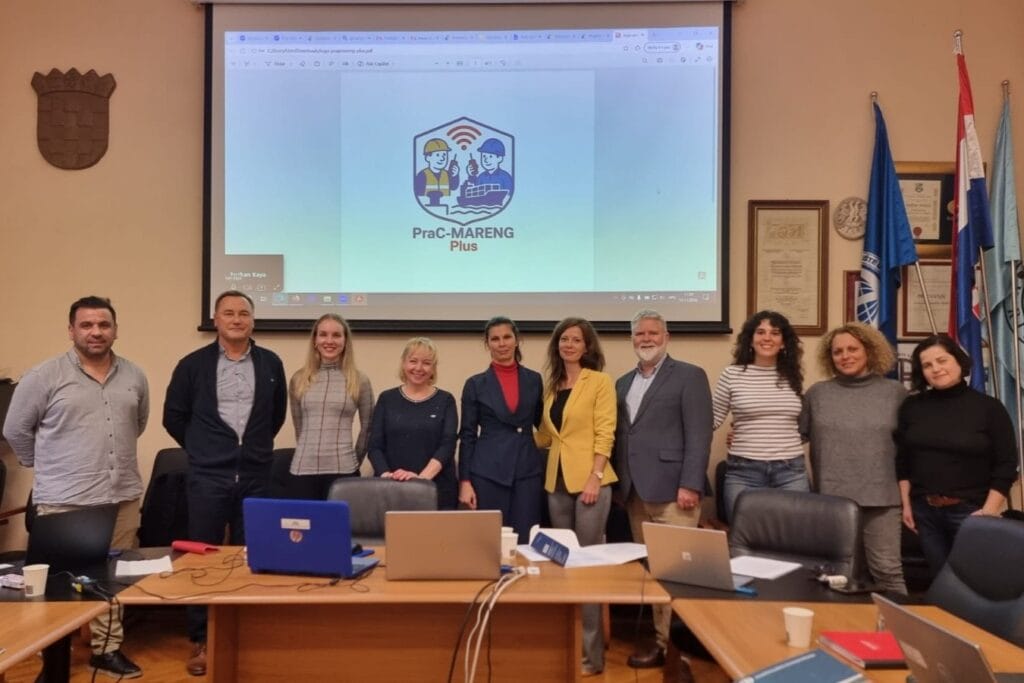
At the project’s third transnational partner meeting, held on 12–13 November 2026 at the University of Rijeka, Faculty of Maritime Studies, partners reviewed the 18-course online offer, examined feedback and discussed the next steps for assessment and piloting.
Connecting specialist content with digital delivery
The academic partners bring expertise in Maritime English and port and shore occupations. Our contribution connects that content with platform development, hosting, interactive learning and technical support.
The online modules include listening exercises, quizzes, occupational scenarios and terminology resources. Bringing these into a coherent learning experience requires ongoing collaboration: authors check the intended meaning and learning outcomes, reviewers flag improvements, and our team implements and tests the digital changes.
This joint work matters when a learner is practising how to clarify an instruction, report a problem or exchange information during a port call.
Making feedback easier to use
During the Rijeka meeting, software developer Furkan Kaya demonstrated the lecturer dashboard, learner and expert questionnaires, and the course/activity-level “Report an issue” function. These routes help partners review feedback and identify exactly where a correction is needed.
Structured questionnaires provide a view of the overall learning experience. Specific issue reports help the team locate problems with instructions, audio, navigation or individual activities. Both contribute to the continuing review process.
Our follow-up work includes supporting clearer navigation, reviewing activity length with content owners and testing complete learner journeys across different devices. These checks connect the way an activity is presented with the way a learner actually uses it.
Preparing the next assessment phase
Partners also discussed how reviewed questions and scenarios can contribute to a shared assessment system. Work ahead includes common assessment rules, useful feedback, reassessment, skill coverage and tests of possible adaptive routes.
Maritime Innovators will contribute technical work on assessment, scoring, reporting and integration alongside the partners responsible for methodology, content review and testing. Certification arrangements and external recognition remain under development.
We welcome practical contributors
We would like to hear from port professionals, Maritime English teachers, maritime employers, students and training providers interested in reviewing relevant activities or arranging testing with a group.
Practitioners can help check operational relevance. Educators can examine learning tasks and feedback. Learners can show us where the online experience needs to be clearer. Organisations can discuss how the materials might fit their teaching or staff development.
Email info@maritimeinnovators.com with your role or organisation, the course area of interest and the type of contribution you could make. We can then agree access and the appropriate review route with the project team.
Explore PraC-MARENG Plus: https://prac-marengplus.com/
Course platform: https://course.prac-marengplus.com/login/index.php
Thank you to the University of Rijeka team for hosting and to our colleagues at Constanța Maritime University, VILNIUS TECH / Lithuanian Maritime Academy, Universidad Politécnica de Cartagena and Munster Technological University for their continued collaboration.
PraC-MARENG Plus is supported by Erasmus+ KA220-HED. Project number: 2025-1-RO01-KA220-HED-000363844.
Funded by the European Union. Views and opinions expressed are however those of the author(s) only and do not necessarily reflect those of the European Union or the European Education and Culture Executive Agency (EACEA). Neither the European Union nor EACEA can be held responsible for them.